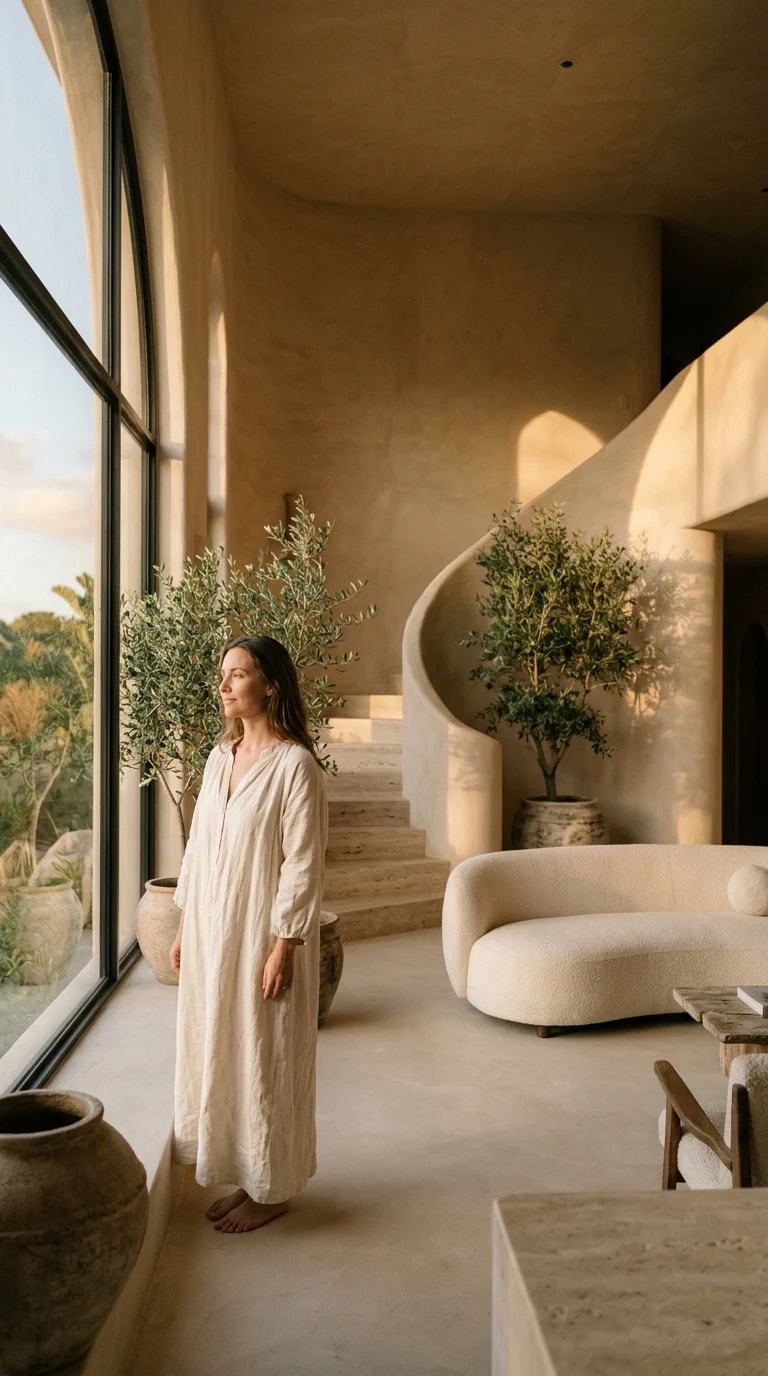
There is a particular kind of stillness that only arrives when a room is built around a single, enormous window. In this home, the glass rises almost two storeys, arched at the top and held by slender black metal mullions that divide the view into tall, elegant panels. A woman in a white dress stands at the sill, barefoot on microcement, looking out. Everything behind her — the curved plaster staircase, the bouclé sofa, the olive trees in terracotta pots — exists in service of that aperture. The black frame is the quiet hero of the composition.
Why does black work so well here, in a palette otherwise built from sand, cream, and clay? Because dark metal gives the eye something to rest against. Without it, a wall of glass in a pale room can feel indefinite, a wash of light with no edges. The black mullions draw crisp vertical lines upward, echoing the arch and lending the space a sense of structure. They read as drawing rather than decoration — thin, deliberate strokes that make the sunlight visible. Notice how the shadows falling across the floor are almost as sharp as the frame itself; the black steel teaches the light how to behave.
Slim profiles matter more than color. A chunky frame would have turned this serene room into a greenhouse or a warehouse. The sections here are narrow enough to nearly disappear in profile, which keeps the view uninterrupted while still providing rhythm. If you are specifying something similar, ask about sightlines before anything else: the width of the frame, the depth of the reveal, and whether the mullions align with the arch's center. Powder-coated steel or aluminum in a matte black finish resists fingerprints and glare far better than gloss, and matte reads softer against textured plaster walls.
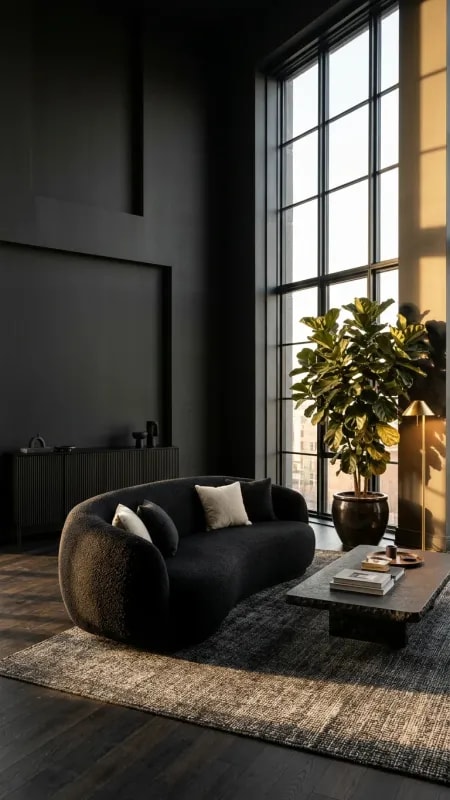
Black frames also solve a practical design problem in warm, organic interiors. When every surface is curved, tactile, and earth-toned, a room can drift toward shapelessness. One disciplined dark element restores tension. Here that tension is repeated subtly — in the shadow line beneath the staircase, in the dark stems of the olive trees, in the iron legs of a side table you can almost imagine just out of frame. The trick is restraint: one strong black gesture, then small echoes. Ten black objects would ruin the calm.
Finally, consider what the window frames in emotional terms. This room is not about display; it is about a morning ritual — coffee, light, a moment of quiet before the day begins. Black steel, for all its industrial pedigree, is capable of real tenderness when it holds a view of trees and sky. It gives the room a spine, and then it steps back. That is the whole lesson of this space: let the dark lines do their work, keep everything else soft, and let the sun finish the design.