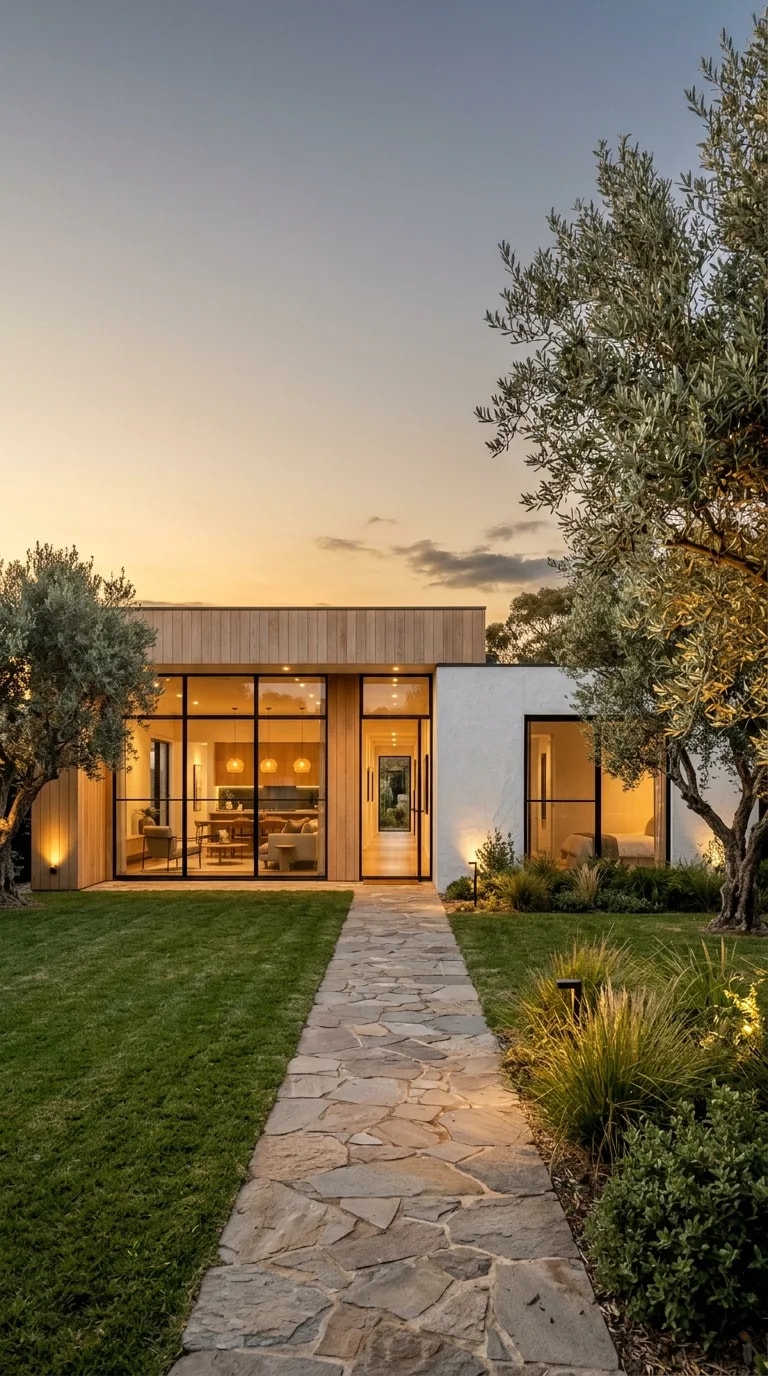
There is a moment just after sunset when a modern house stops being a building and becomes a lantern. The wide glass wall goes dark, the interior lights come up, and suddenly every chair, table and lamp inside is on display — framed by olive trees and reached by an irregular stone path that cuts straight through the lawn. That is the moment worth designing for. In a home with a generous glass facade, furniture is no longer private. It is the warm amber core of the exterior, and it deserves the same thought you give to siding or landscape lighting.
Start with silhouette, because silhouette is what reads from twenty feet away on the path. Low, horizontal pieces keep the view calm: a long sofa with a clean back, a bench tucked under the window, a sideboard that sits below the sill line. Tall, spindly furniture chops the glowing rectangle into nervous fragments. Save the vertical interest for a single floor lamp or a sculptural chair placed deliberately off-center. Materials matter too — warm woods, camel and clay upholstery, linen in oat and rust all turn honey-colored under 2700K bulbs, while cool grays and glossy blacks go flat and slightly cold against a dusk-blue sky.
Lighting is the second layer, and it is the one most glass homes get wrong. Recessed downlights alone create a bright ceiling and a dark floor, which from outside looks like an empty room. Instead, build pools of light at seated height: table lamps on consoles, a pendant dropped low over a dining table, a pair of wall sconces echoing the exterior sconces on the stucco. Carrying the same fixture family from the porch to the living room creates a rhythm the eye follows through the glass. Put everything on dimmers and run the interior slightly brighter than the garden — that gradient is what makes a house feel inhabited rather than staged.
The stone path does quiet work here as well. It sets the pace of approach, so arrange the first few feet of interior space as a welcoming composition: one anchoring piece, one plant, one light, nothing more. Keep the zone immediately inside the glass visually light, and let the richer layering begin three or four steps in. At night, glass also turns mirror-like, so test your arrangement after dark and add exterior lighting to soften reflections. Choose performance fabrics where sun is strong, and rotate textiles with the seasons. Do this well and the reward is simple: every evening, the walk home ends in a glow that is unmistakably yours.