American home design has never been shy about scale. Great rooms sprawl, kitchens open wide, and front doors announce themselves. But the style's real genius shows up in the corners nobody planned for — the slice of wall between a window and a hallway, the dead zone beside a bookshelf. That is where the American instinct for comfort beats out the urge to impress. This reading nook is a small masterclass in that instinct: one chair, one table, one plant, and a rug doing quiet structural work beneath it all.
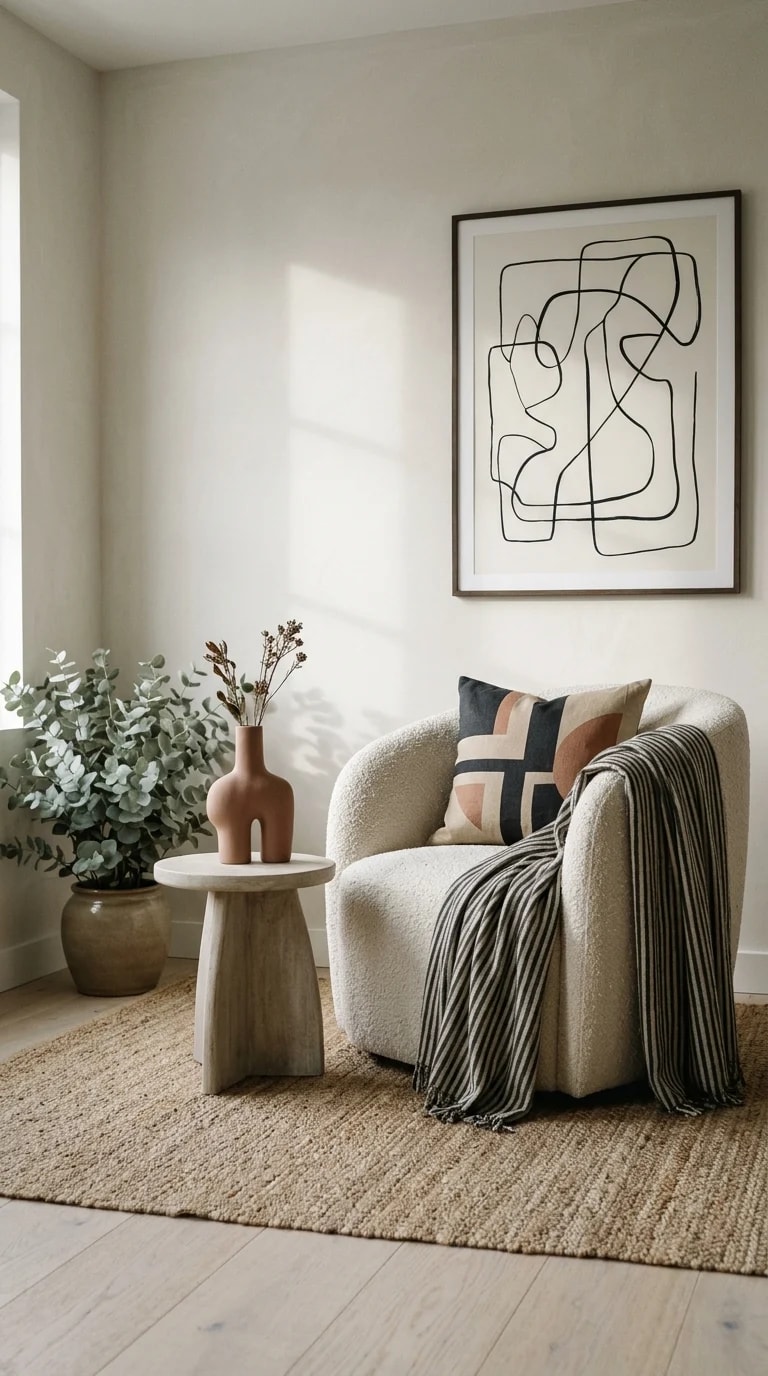
The anchor is a curved cream boucle armchair, the kind of silhouette that has edged out stiff wingbacks in newer American interiors. Its low, rounded back wraps rather than corrects, and the nubby texture picks up light in a way flat upholstery never does. Against an off-white wall, the chair reads almost as sculpture, which is why the styling around it stays restrained. A geometric color-block pillow in navy, cream, and terracotta does the heavy lifting on pattern, and a black-and-white striped throw is draped rather than folded — a deliberate bit of mess that signals the seat actually gets used.
Furniture choices here follow the American habit of mixing eras without apology. The side table is chunky, light-toned wood with visible grain, closer to a workshop bench than a formal end table, and its weight balances the chair's softness. On top, a sculptural terracotta vase holds dried stems instead of fresh flowers — a practical choice that keeps the palette warm and rust-toned year-round. To the left, a large faux eucalyptus in an earthy pot fills the vertical space and softens the transition to the wall. A framed abstract line-art print hangs at a comfortable eye level, its thin black strokes echoing the throw without competing with it.
What holds the composition together is the floor. A woven jute rug in a natural beige defines the nook without cutting the room in half, and it gives the light wood planks a warm, matte counterpoint. Soft daylight arrives from the left, casting crisp angled shadows across the wall and rug — shadows that do as much for the mood as any object in the frame. The palette stays disciplined: beiges and warm rusts, grounded by graphic black accents that keep the scheme from floating away into beige-on-beige.
Copy this corner and you get more than a pretty photograph. You get a rule for American-style rooms: pick one shape to lead, layer two textures, add one hit of pattern, and let the light finish the job. The result is a chair you actually sink into — and a corner that finally earns its square footage.