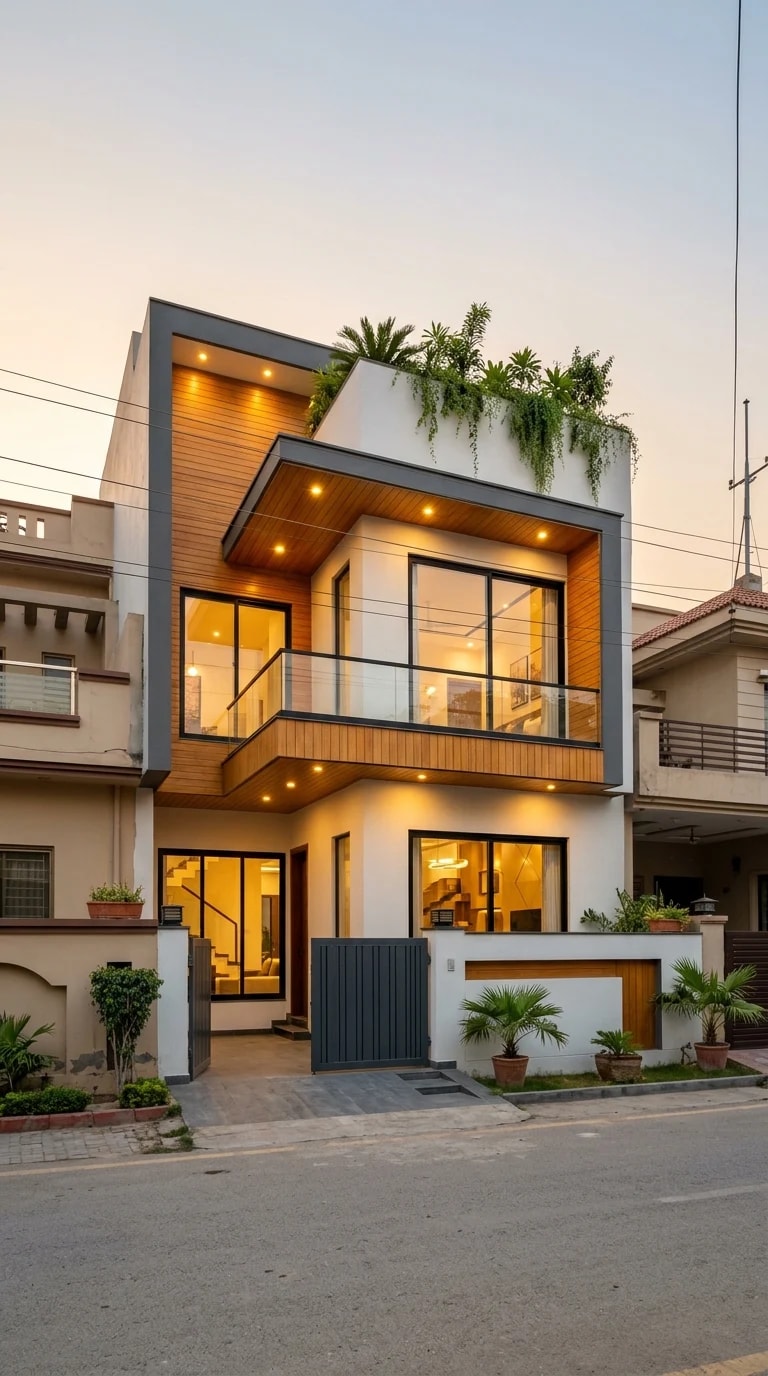
Twilight is the honest hour for a house. Floodlights and porch lamps can flatter almost anything, but the soft blue-to-peach sky of early evening shows what a facade really does with shadow, depth, and glow. This two-story home answers beautifully: crisp white panels, a charcoal frame that reads like drawn lines, and vertical wood slats running warm against all that cool grey. Behind the floor-to-ceiling glass, interior light spills out in amber bands, so the house looks less like a structure and more like a lantern someone left on for you.
That mix is the heart of contemporary American style right now. The old shorthand, shutters, gables, and a picket fence, has given way to something more confident and more material-driven. Designers are treating the exterior as a composition of honest surfaces: smooth panels for lightness, dark trim for definition, and real wood for the warmth that keeps modern architecture from feeling cold. The result borrows from mid-century case study houses and Pacific Northwest modernism alike, then settles into a vocabulary that works in almost any American climate. Nothing is decorative for its own sake. The beauty comes from proportion and contrast.
Glass does the heavy lifting. Here, the windows run nearly floor to ceiling across both levels, interrupted only by slim mullions and a balcony with a clear railing that almost disappears against the sky. That transparency is a commitment, and it needs a strategy: sheer interior shades, carefully placed lighting, and landscaping that buffers the street side while opening the view at the back. Recessed exterior lights tucked under the eaves extend the effect after dark, washing the white panels in a soft glow and letting the charcoal frame stay dark and graphic. Layering warm interior light with cooler exterior light is what gives the house its depth at night.
Greenery softens the geometry without fighting it. Trailing plants spill from rooftop planters along the upper edge, breaking the hard line of the roof and adding a living texture that shifts with the seasons. At ground level, a dark metal gate and a clean paved drive handle the arrival sequence, giving visitors a moment of threshold before the front door. It is a small piece of choreography, but it matters; a house that stages its own approach feels intentional rather than merely built.
If you want to borrow the look, start with a three-part palette: a bright neutral for the broad surfaces, a deep charcoal for frames and railings, and one natural wood tone used sparingly where hands and eyes will linger. Then invest in lighting. The magic here is not the panels or the glass alone, but the way a warm interior meets a cooling sky and makes a modern house feel like somewhere you would actually want to come home to.