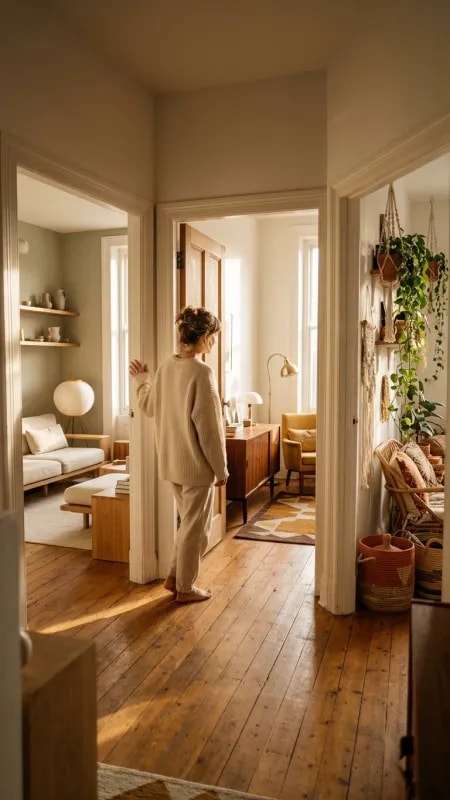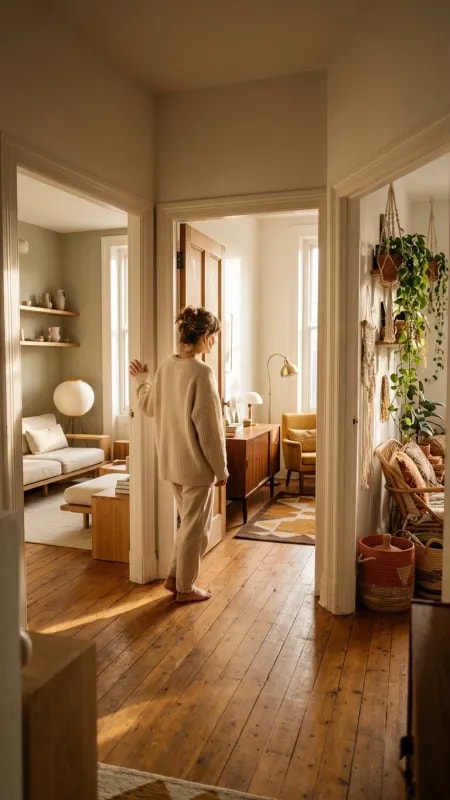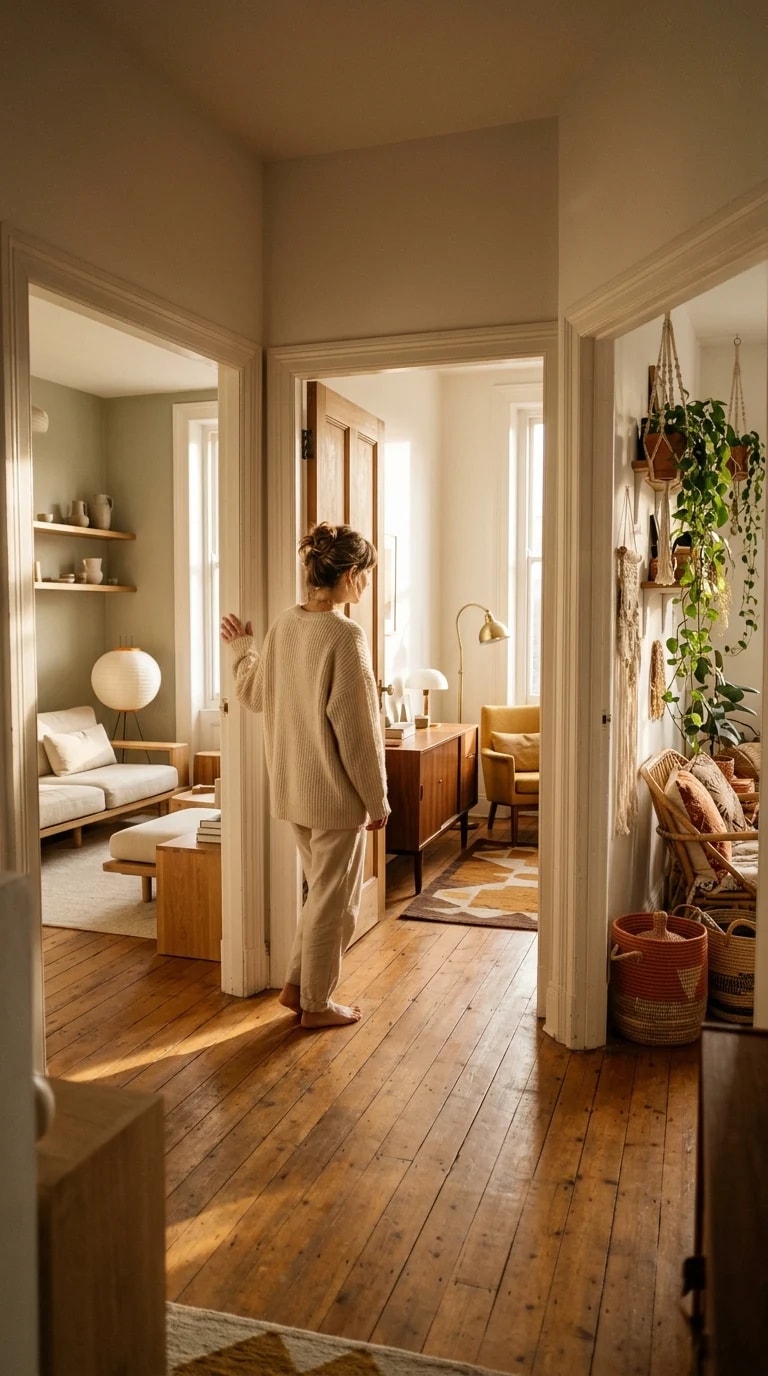
There is a particular pleasure in a hallway that refuses to be just a passage. Here the corridor widens into a junction of three openings — a living room to the left, a study straight ahead, a green corner to the right — and a woman in a beige knit pauses mid-step, as if deciding which small pleasure to walk into. Because the camera sits low and upright, each doorway becomes a frame inside the frame, stacking one room behind another. That nesting is what makes the image linger. It is the kind of composition that reads instantly as a home design poster, not because anything is staged to perfection, but because the architecture is doing the storytelling.
Thresholds are the most underrated square footage in any house. A doorway is a view before it is a door, and how you dress that view decides whether a home feels generous or tight. Notice what each opening reveals: a pale sofa and round globe lamp against open shelving in the living room; a wooden desk, brass task lamp, and single chair in the study; trailing greenery in macramé hangers, a rattan chair, and stacked woven baskets on the right. Each room offers one clear silhouette rather than a jumble of objects. From the hallway, your eye lands on a shape, then drifts. That restraint is the whole trick — give every sightline a hero and let the rest recede.
The palette carries the calm. Cream and sand run continuously through walls, upholstery, and the woman's own clothing, while honeyed wood floors warm everything from below. Sage green arrives only through leaves; terracotta appears in a single ceramic or basket. Because no hue argues with its neighbour, the rooms feel like one house rather than three separate decorating projects. Keep a continuous floor, repeat one or two tones across every opening, and the hallway stops being a border and becomes the connective tissue.
Light does the remaining work. Long afternoon shadows stretch across the planks, and the globe lamp, brass desk lamp, and window glow layer warm pools at different heights. If you are rebuilding a similar junction, treat the floor as a light path: keep it clear, choose a matte finish that softens glare, and place your lowest light sources where shadows can travel. Textiles — the knit, the woven baskets, the trailing plants — add the softness that stops a tidy corridor from feeling like a showroom.
What stays with you is the pace. Nobody is rushing. The rooms are ready, the light is low and gold, and the doorway is an invitation rather than a boundary. Design for that feeling and your hallway becomes the most photographed corner of the house.