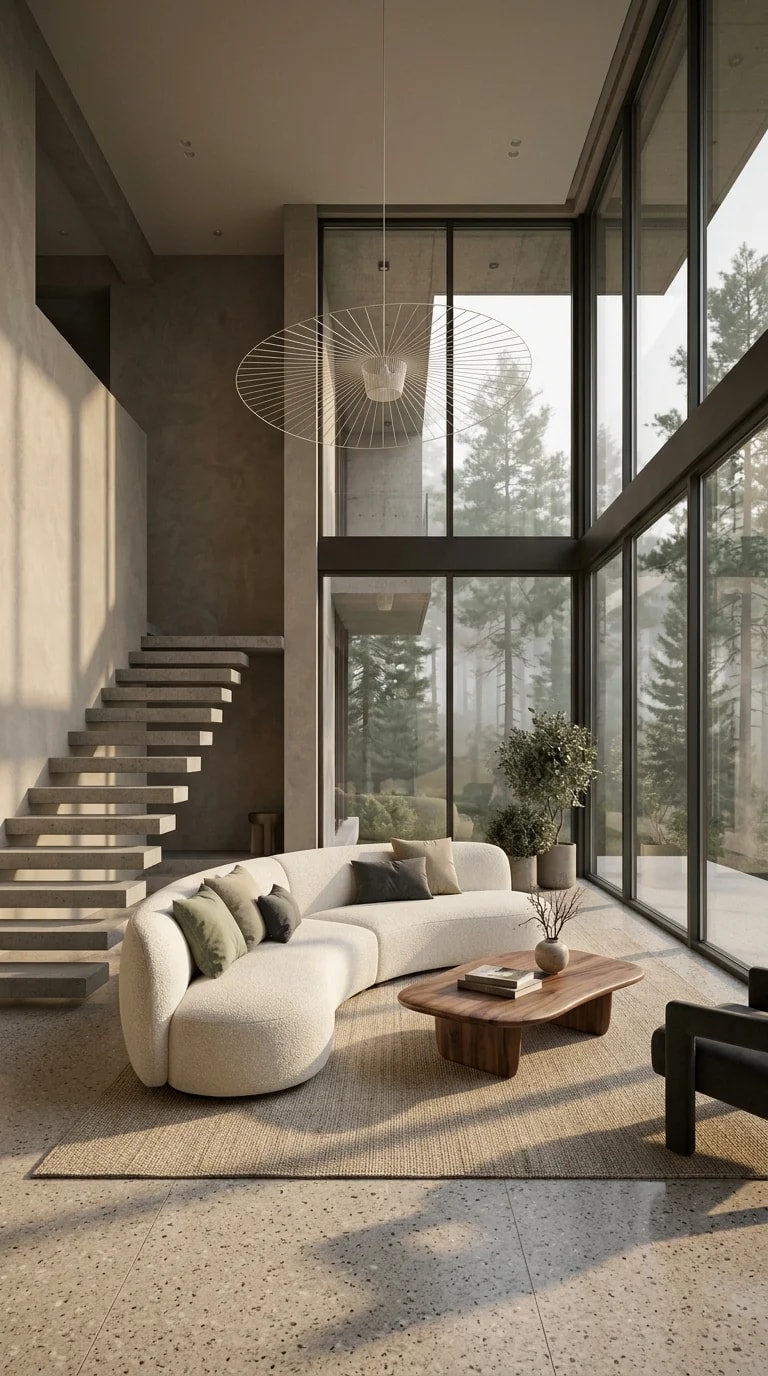
Most home offices are planned backwards. We start with the desk, push it against a wall, and squeeze everything else into the leftover inches. The room in this image suggests the opposite sequence: build the calm first, then let the work surface settle into it. What you see is essentially a lounge — a curved cream sofa floating on a textured beige rug, a low organic wood table holding books and a single branch in a slender vase — set inside a double-height shell of concrete, black steel and glass. Nothing here announces productivity, yet it reads as one of the most focused rooms imaginable.
The first lesson is curvature. Every hard plane in the architecture — the concrete walls, the black-framed glazing, the floating stair treads — is answered by something soft. The sofa bends, the rug thickens the floor, and the branch vase introduces an irregular line no manufactured object could supply. In a small spare room, one curved chair or a round low table does the same work, breaking the grid of desk and shelving so your eye has somewhere to rest between tasks.
The second is scale, borrowed from nature. Those towering windows do more than admit light; they frame a misty pine forest like a painting that changes hourly. Few of us can install a glass wall, but the principle survives translation. Place your desk perpendicular to the window rather than facing it, so the view enters your peripheral vision instead of competing with your screen. A single tall plant — a ficus, an olive, anything with real structure — can stand in for the forest, and a low bowl of branches will echo the table styling without demanding care.
Light here is raking and directional, throwing long shadows across the concrete floor, and the sculptural wire pendant hangs as an object rather than an interrogation lamp. Copy that layering in a domestic room: soft ambient light bounced off a pale ceiling, a focused task light at the desk, and something warm and low for the evening. Shadows are not a flaw to be eliminated; they are what makes the room feel deep instead of flat.
Finally, restraint. The palette is narrow — cream, taupe, concrete gray — with black accents and a single stroke of forest green doing all the shouting. Editing down to three neutrals and one accent is the fastest route to a room that feels quiet, because quiet is mostly a matter of fewer decisions per glance. Leave one surface deliberately empty, keep the floor visible under the furniture, and treat the space behind your chair as somewhere to exhale. The desk is only one object in the room; the calm around it is what makes the work possible.