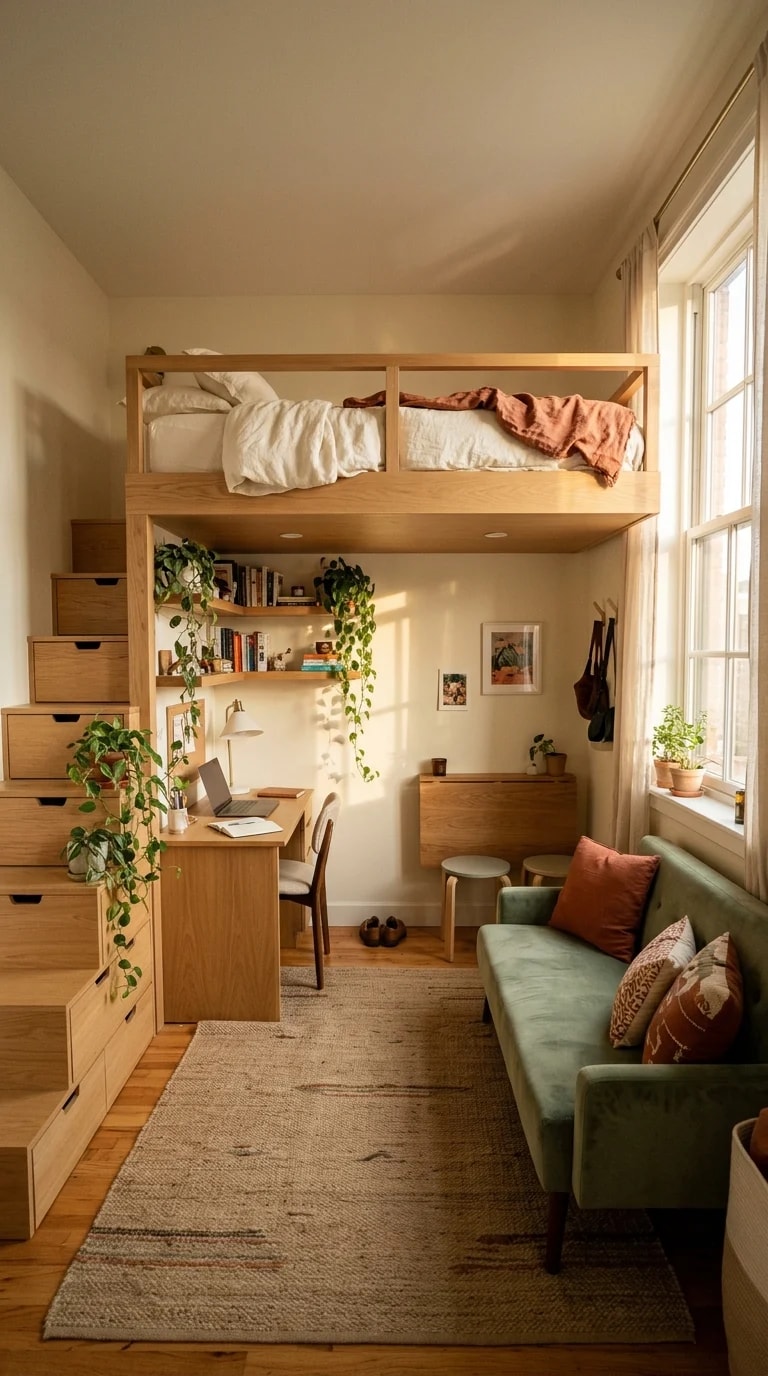
The most convincing argument for zen home office design is not a minimalist white room with a single orchid. It is a tight, low-ceilinged corner under a wooden loft bed where everything has a place and nothing shouts. In this room, a slim desk holds a laptop and little else, floating shelves rise in a quiet vertical line, and trailing plants soften the hard edge of the structure above. The result is a workspace that feels intentional rather than improvised, which is exactly the feeling most of us are chasing when we say we want calm.
The palette does most of the emotional work. Light wood frames the loft, the stairs and the desk, giving the small footprint a single warm note that repeats instead of competing. Cream bedding and a woven rug keep the upper half airy, while sage green on the sofa and rust in the cushions and throws add just enough contrast to stop the room from going flat. Notice how the darkest tones sit low and to the sides, in the small cabinet and the patterned textiles, leaving the center of the composition open. That is a deliberate hierarchy, and it is easy to copy: keep the biggest surfaces pale, put color in the middle scale, and let shadowy accents anchor the edges.
Light is the second pillar. Daylight arrives from a single window on the right and washes across the desk, so the working surface is bright without a lamp during the day. If your own office corner is darker, resist the urge to flood it with overhead light. A warm-toned task lamp placed opposite your dominant hand, plus a sheer curtain to diffuse a hard afternoon sun, gets you closer to the soft, golden quality you see here. Shadows are not a flaw in a zen room; they are what give it depth and make the lit areas feel restful.
Storage is where calm is either won or lost. In this room, the stairs double as drawers, shelves stay shallow and sparse, and a low cabinet hides the clutter that would otherwise land on the desk. The lesson for a small home office is to build vertical storage that ends above eye level when you are seated, so the space in front of you stays visually clear. Books are grouped rather than lined up end to end, frames are hung in a small cluster instead of spread across the wall, and the plants are the only things allowed to spill over their edges.
Finally, let the room do double duty without letting it blur. The desk faces the open floor rather than the wall, so the chair can turn toward the sofa when the workday ends, and the loft above reads as a separate zone even though the square meters are shared. That small ritual, turning a chair and closing a laptop, is what turns a corner of a bedroom into a place you can actually concentrate in. Wood, green, soft light and a short list of objects: that is the whole formula, and it fits under a bed.