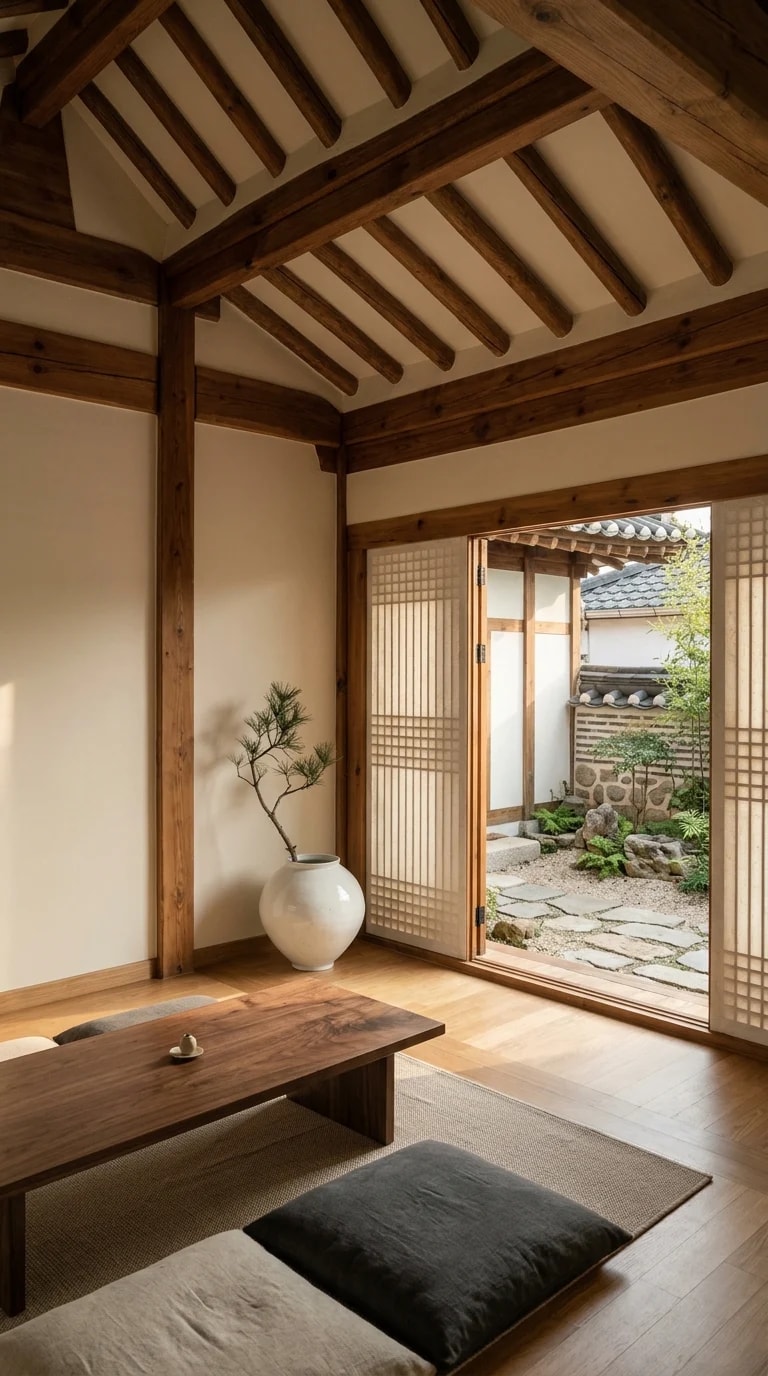
Look closely at this living room and you will notice what is missing. There is no black rectangle, no floating shelf of cables, no wash of LED glow along the ceiling. Instead there is a low dark-wood table, floor cushions around a woven rug, a single white ceramic vase holding one bare branch, and exposed timber beams crossing cream plaster walls. Beyond the open lattice doors, a stone courtyard and tiled roofline do the work a screen usually does: they hold the eye. The room is quiet, grounded, and unmistakably finished.
That is the most useful thing this space teaches anyone planning a home design tv wall. Most projects begin with the screen, then arrange furniture around it and hope the result feels intentional. Hanok architecture works the other way around. First you decide where the light enters, where people sit, what they should be looking at when nothing is switched on. The focal point here is a doorway and a garden. Everything else, including any future media equipment, is secondary architecture.
Translate that sequence into a modern living room and the television stops dictating the composition. A wall can be designed as joinery first: timber panels, plaster, a low console in dark stained oak, a symmetrical arrangement that reads as furniture rather than electronics. When the screen is needed, sliding lattice doors or a fold-back cabinet can close over it, echoing the courtyard doors in this image. Slatted wood fronts let sound and remote signals pass through while the panel stays hidden. The result is a wall that looks resolved at eight in the evening and equally resolved at eight in the morning, when nobody is watching anything.
Materials carry the mood. Warm browns, cream, beige and charcoal keep the palette calm, and matte finishes avoid the glare that glossy media walls invite. Low seating protects sightlines to the garden, so the view stays part of the room even from the floor cushions. Lighting should come from the side, soft and warm, rather than from a strip hidden behind the screen. Restraint does the rest: one branch in a vase is more powerful than a shelf of objects competing with a moving image.
Here is a simple test before you commit to a layout. Cover the television with a sheet or remove it from the drawing entirely, then ask whether the wall is still beautiful. If the answer is no, the design is not finished. Build the plaster, the timber, the view and the seating first. The screen can come later, and it can leave again whenever the garden is more interesting.