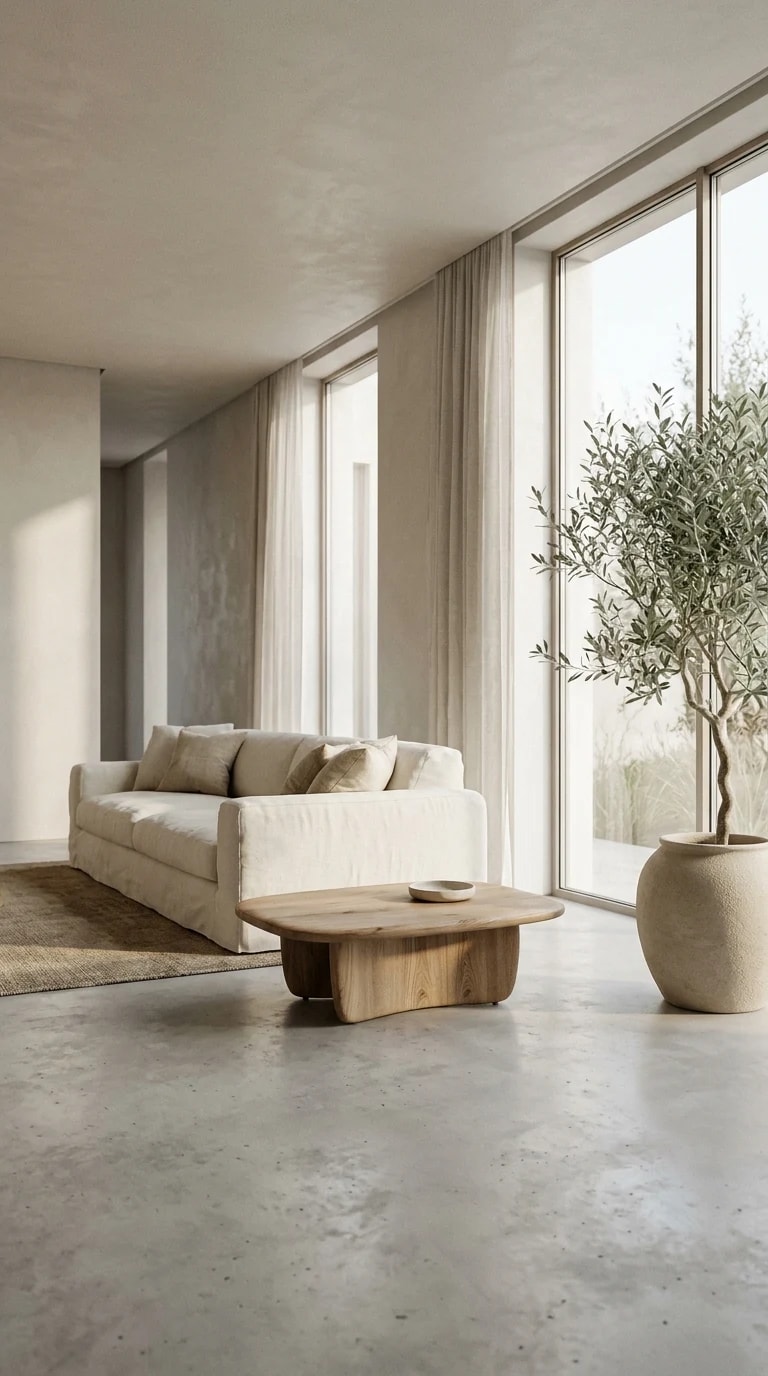
There is a moment in this room where nothing happens, and that is precisely the point. A low cream sofa sits well back from the glass, a sculptural wooden coffee table holds a single object, and a jute rug marks the seating zone without shouting about it. Between these few pieces stretches a wide, polished concrete floor, cool and softly reflective, and above them rises an uninterrupted ceiling. The room is small. It simply refuses to behave that way.
The trick is not furniture arranged cleverly, though the arrangement is good. It is the deliberate reservation of empty floor and empty air. In compact rooms we tend to fill the middle, as if bare ground were waste. Here the opposite logic applies: the largest single material in the room is the floor itself, left almost entirely clear so the eye can travel its full length without interruption. Low-profile seating keeps sightlines flat and lets the walls and windows do the work of making the ceiling feel taller than it is. Anything taller, bulkier, or more patterned in the center of the room would have closed the space down in an instant.
The palette reinforces that openness. Bone, sand and soft gray sit close enough in value that surfaces blur gently into one another, so the eye reads one continuous, quiet field rather than a patchwork of objects. Texture does the talking instead: the nubby weave of the sofa, the grain of the wood, the rough twist of the jute, the faint sheen of the concrete. A single muted olive green enters through the tree in its rounded beige pot, and because it is the only strong color in the frame, it earns far more presence than a dozen patterned cushions ever could.
Light is the other collaborator. Floor-to-ceiling glazing on the right pours diffused daylight across the room, catching the concrete and throwing soft, long shadows that give the flat surfaces depth. Notice how little sits in front of that glass. Nothing blocks the view outward, so the room borrows the sky and whatever lies beyond it, gaining an extra dimension a small footprint could never build on its own.
If you want the same calm at home, start by subtracting rather than adding. Clear a generous margin around your seating, choose pieces that stay low, keep your colors within a narrow warm range, and let one living thing — a plant, a branch, a bowl — carry the accent. A small house does not need to look full. It needs room to exhale.