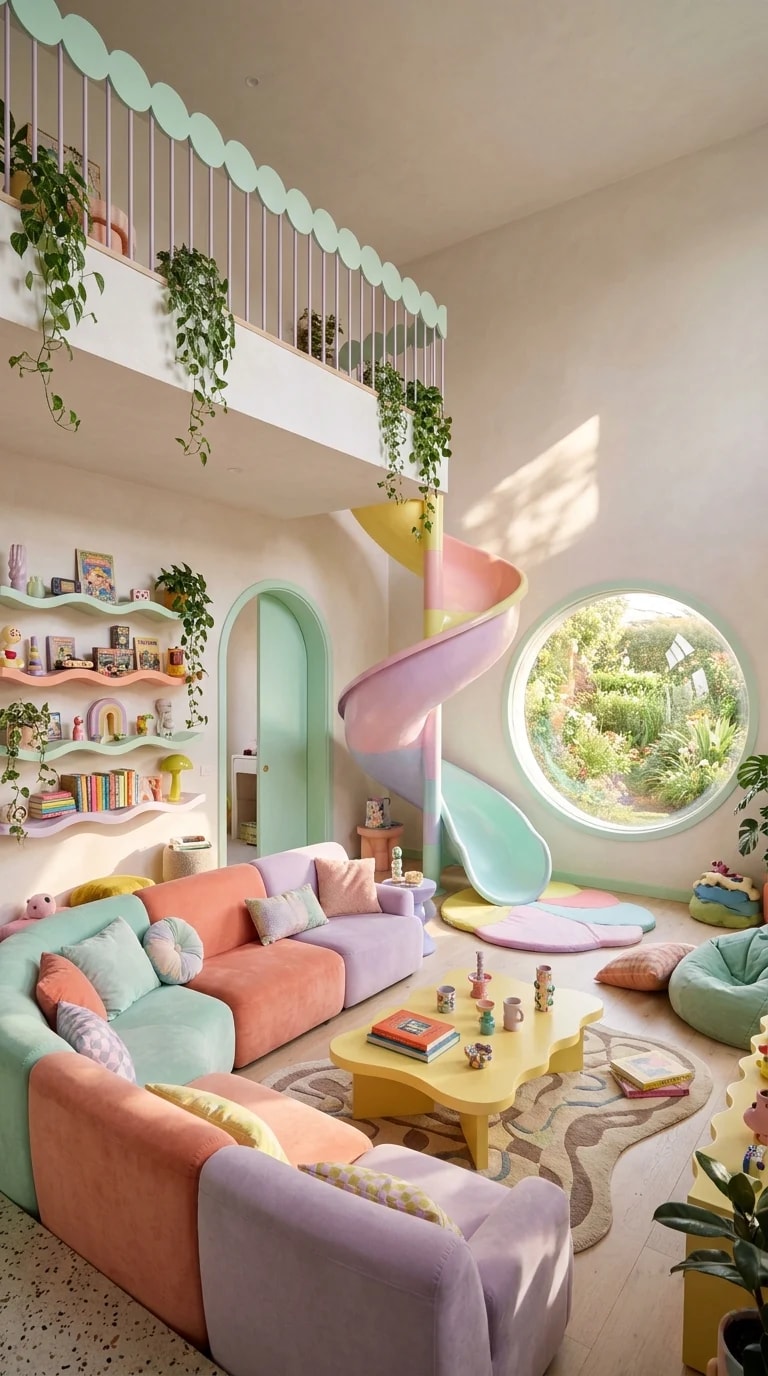
The first thing you notice isn't the sofa or the shelves. It's the slide. A spiral chute curls down from a mezzanine level into the middle of a living room that, by any floor plan, should feel cramped. Instead it reads as generous, almost loft-like, because every design decision here answers the same question: how do you get more room without adding any? The answer, in this house, is to stop measuring in square feet and start measuring in cubic ones.
The mezzanine does the heavy lifting. By lifting the play area up and tucking it under the ceiling, the ground floor keeps its full width for living. The railing that edges it is the smartest detail in the room: a white balustrade finished with a scalloped mint trim, which turns a safety requirement into sculpture. Curved built-in shelves follow the same logic, wrapping a corner instead of jutting into it, so storage reads as architecture rather than furniture. And the slide? It's circulation, entertainment, and a piece of joinery all at once — proof that a staircase doesn't have to be the only way between two levels.
Color is doing quiet work too. The base is creamy and light, then mint, peach, lilac, and butter yellow arrive in soft, low-saturation blocks: a modular sectional on low legs, a yellow coffee table scattered with books and toys, a wavy rug that softens the floor plane. Because the tones are pale and the furniture sits low, sightlines stay open all the way to the round window, where the garden pours green light into the room. That window is a small-space trick worth stealing — a circle instead of a rectangle frames the outdoors like a picture and makes the wall feel less like a boundary.
If you want to borrow the spirit for your own compact house, start with height. Look for ceiling space you're not using, then ask what could float there: a sleeping platform, a reading nook, a play loft. Keep the furniture low and leggy so the eye travels, run storage into curves and corners, and let one bold element — a slide, a ladder, a swing — carry the room's personality. Hang plants high, paint the railing a color you love, and let daylight do the rest. Small houses don't need to feel small; they need to be designed with a little nerve.