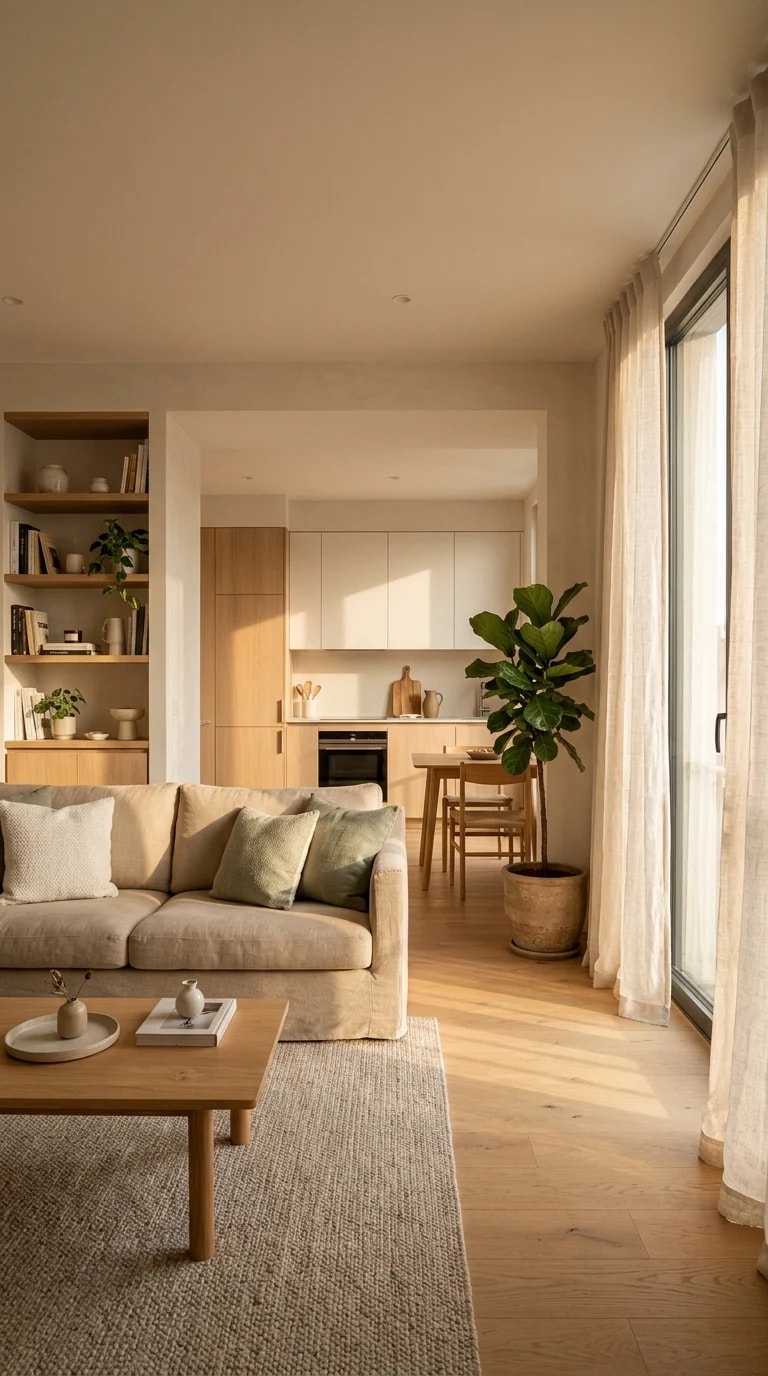
The first thing this room does is refuse to end. A beige sofa and a light oak coffee table sit close enough to touch, but your eye keeps moving past the built-in shelves, through the wide doorway, over the dining table, and out to the fig tree in the corner of the kitchen. Nothing blocks the view. In an old-style home, that long unbroken sightline was never an accident of architecture; it was the whole point. Rooms were arranged so one could borrow depth, light, and company from the next.
What makes the arrangement read as old rather than merely open is the repetition of materials. The same pale oak runs underfoot from the living area into the kitchen. The cream walls hold steady on both sides of the doorway. Sage shows up on the sofa cushions and again, faintly, in the ceramics on the shelves. Nothing in the kitchen announces itself as a different room with a different personality. Old houses worked this way because materials were expensive and finishes were few, so a single floorboard or a single wall colour carried through the entire ground floor. Copy that discipline and an open plan stops feeling like a warehouse.
The depth is built from three simple moves. Low furniture keeps the middle of the floor clear so the eye can travel at seated height. One tall vertical element, here the sheer curtains and the fig, gives the far wall something to reach toward. And the shelves stop short of the ceiling, leaving wall above them, which makes the room feel taller than it is. Wide doorways without casings or with very slim ones let the two spaces share a single ceiling plane.
Light does the rest. Sun comes in low from the right, dragging long soft shadows across the floorboards and warming the honey tones in the oak. Sheer curtains are the old-fashioned answer to harsh afternoon glare: they soften without blacking anything out, and they keep the glass doors reading as a source of light rather than a dark rectangle. Pale floors underfoot bounce that light back up into the room.
Then there are the traces of use. Trays left on the coffee table, books stacked unevenly, ceramics that do not match, a plant trailing off the shelf because nobody trimmed it. Old-style design was never pristine; it accumulated. Leave a little of that accumulation in place and the room stops performing and starts living.